The VMware Inflection Point in Higher Education
Broadcom’s VMware changes are driving 150% – 1,250% price increases for universities. Learn why higher-ed institutions are reassessing VMware.

Paul Shulman leads Anantyx with a clear vision: simplify AI and cloud management and empower every user.
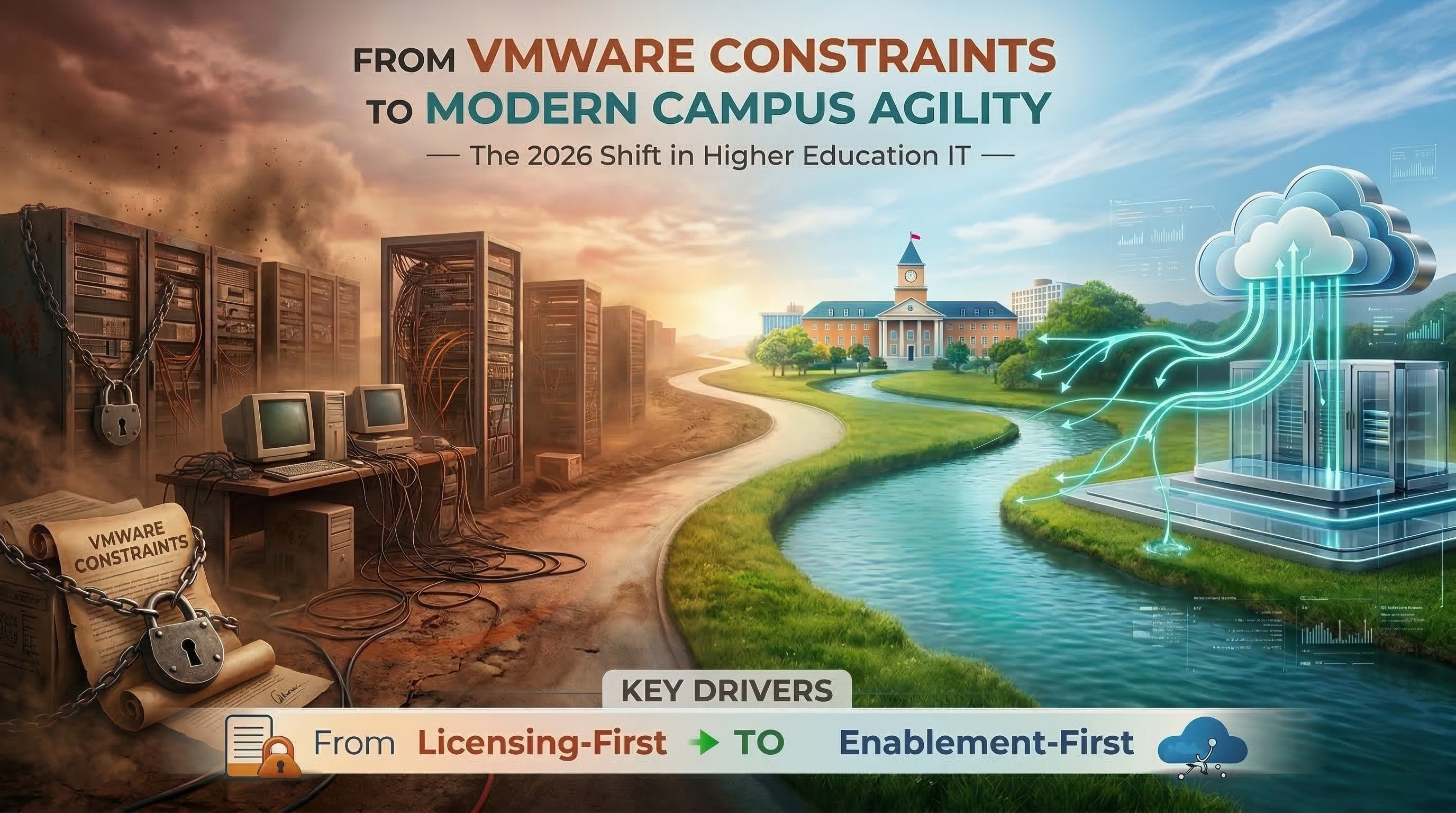
The VMware Inflection Point in Higher Education: Why Universities Are Reconsidering Their Infrastructure Strategy
TL;DR
- Broadcom's VMware acquisition has triggered dramatic price increases, forcing higher education institutions to urgently rethink their infrastructure strategy
- The challenge isn't just cost - it's operational: research, hybrid work, and AI workloads all demand flexibility that legacy virtualization can't deliver
- Cloud migration isn't a silver bullet without the right governance layer in place
- Institutions that act now have the opportunity to modernize infrastructure while cutting costs - those that wait face compounding licensing pressure with fewer options
For more than a decade, VMware has been the backbone of higher education IT. It powered campus data centers, virtual desktop infrastructure (VDI), research simulations, and cybersecurity labs. Many universities became deeply embedded in the VMware ecosystem.
In 2026, that dominance reached a strategic inflection point.
Following Broadcom’s acquisition, VMware’s commercial and operational model has changed significantly. Gartner predicts VMware will lose 35% of its total workload by the end of 2026 as institutions migrate to more agile platforms.
This is not routine vendor churn.
It is a structural re-evaluation of infrastructure strategy across higher education.
1. Financial Shock: Subscription Restructuring and Cost Escalation
The most immediate driver of VMware migration in higher education is financial.
Institutions report:
- Annual cost increases ranging from 150% to 1,250%
- Support costs rising from $55,000 to $675,000 in some cases
- A mandatory 72-core minimum licensing threshold
The shift from perpetual licenses to bundled subscription models has created what many CIOs describe as a sudden budget shock.
The 72-core minimum disproportionately impacts smaller campuses or distributed server environments. Institutions may be forced to license capacity they do not fully use.
For public universities already facing funding volatility, this creates:
- Multi-year cost exposure
- Reduced budget flexibility
- Pressure on tuition or program allocation
The VMware conversation is no longer about technical preference. It is about cost governance and fiscal predictability.
2. Hardware Deprecation and Forced Refresh Cycles
VMware environments have historically required strict hardware compatibility.
Institutions now face:
- Deprecation of 3–5-year-old servers
- Forced capital expenditures to replace otherwise functional equipment
This creates an uncomfortable pattern: software policy driving hardware spending.
Instead of refreshing infrastructure based on academic demand, universities are refreshing to maintain vendor support alignment.
At scale, this introduces:
- Unexpected CapEx
- Data center reinvestment
- Competing priorities between IT and academic programs
In a constrained funding environment, these tradeoffs are increasingly difficult to justify.
3. AI and Research Workloads Outpacing Legacy Virtualization
Modern AI research environments require:
- Dynamic GPU allocation
- High-throughput data processing
- Elastic scaling
- Temporary sandbox provisioning
Legacy virtualization was not architected for GPU-intensive, burst-based AI workloads .
At the same time, institutions are increasingly wary of cloud vendor lock-in . Strategic autonomy matters when infrastructure decisions affect research competitiveness and grant eligibility.
Universities need platforms that allow them to:
- Scale GPU environments dynamically
- Shut down idle research labs automatically
- Maintain cloud flexibility
- Avoid single-vendor dependency
4. Operational Friction and Resource Hoarding
Traditional VMware environments often rely on centralized IT teams to provision and manage workloads.
Common issues include:
- Manual provisioning
- Environment “hoarding”
- Idle virtual desktops consuming budget
- Limited cost visibility at the department level
Your use-case document highlights “resource hoarding” as a recurring challenge: environments that remain powered on despite inactivity.
When budgets tighten, this inefficiency becomes visible.
Modern orchestration models shift from infrastructure control to automated stewardship:
- Automatic shutdown of unused environments
- Hardware-agnostic orchestration
- Simplified server management workflows
The difference is philosophical:
From licensing-first to enablement-first.
5. The Strategic Question Facing CIOs and CFOs
Higher education leaders are now asking:
- What is our 3-year VMware exposure under new subscription terms?
- How much licensed capacity goes unused?
- Are hardware refreshes aligned to academic need or vendor requirements?
- Can our infrastructure support AI-driven research without redesign?
- What is our vendor concentration risk?
This is why VMware migration in higher education is accelerating.
The issue is not dissatisfaction with virtualization technology.
It is a misalignment between legacy licensing models and modern institutional demands.
The Bottom Line
The VMware transition underway in higher education is driven by three converging pressures:
- Financial unpredictability
- Hardware and lifecycle constraints
- AI-readiness and sovereignty concerns
When all three shift simultaneously, platform reevaluation becomes inevitable.
Institutions that proactively model their exposure and modernization path will have greater control over cost, agility, and research competitiveness.
In our next post, we will break down a structured financial modeling framework for evaluating VMware replacement in higher education.
_compressed.jpg)
_With%20Logo.jpg)