Multi-Cloud Interoperability, Governance & Cost Control
Learn why multi-cloud interoperability is now a strategic requirement. Reduce vendor lock-in, control cloud costs, and unify governance.

Konstantin brings the Anantyx vision to life through exceptional technical execution.
Multi-Cloud Interoperability: Why It’s Now a Strategic Requirement, Not an IT Preference
Most organizations are already multi-cloud, intentionally or not.
They operate across AWS, Azure, private data centers, SaaS platforms, containers, and often legacy VMware environments. But while infrastructure has diversified, management and governance have not.
The result is fragmentation:
- Inconsistent APIs
- Siloed cost controls
- Duplicated tooling
- Cloud-specific skill dependencies
- Governance gaps
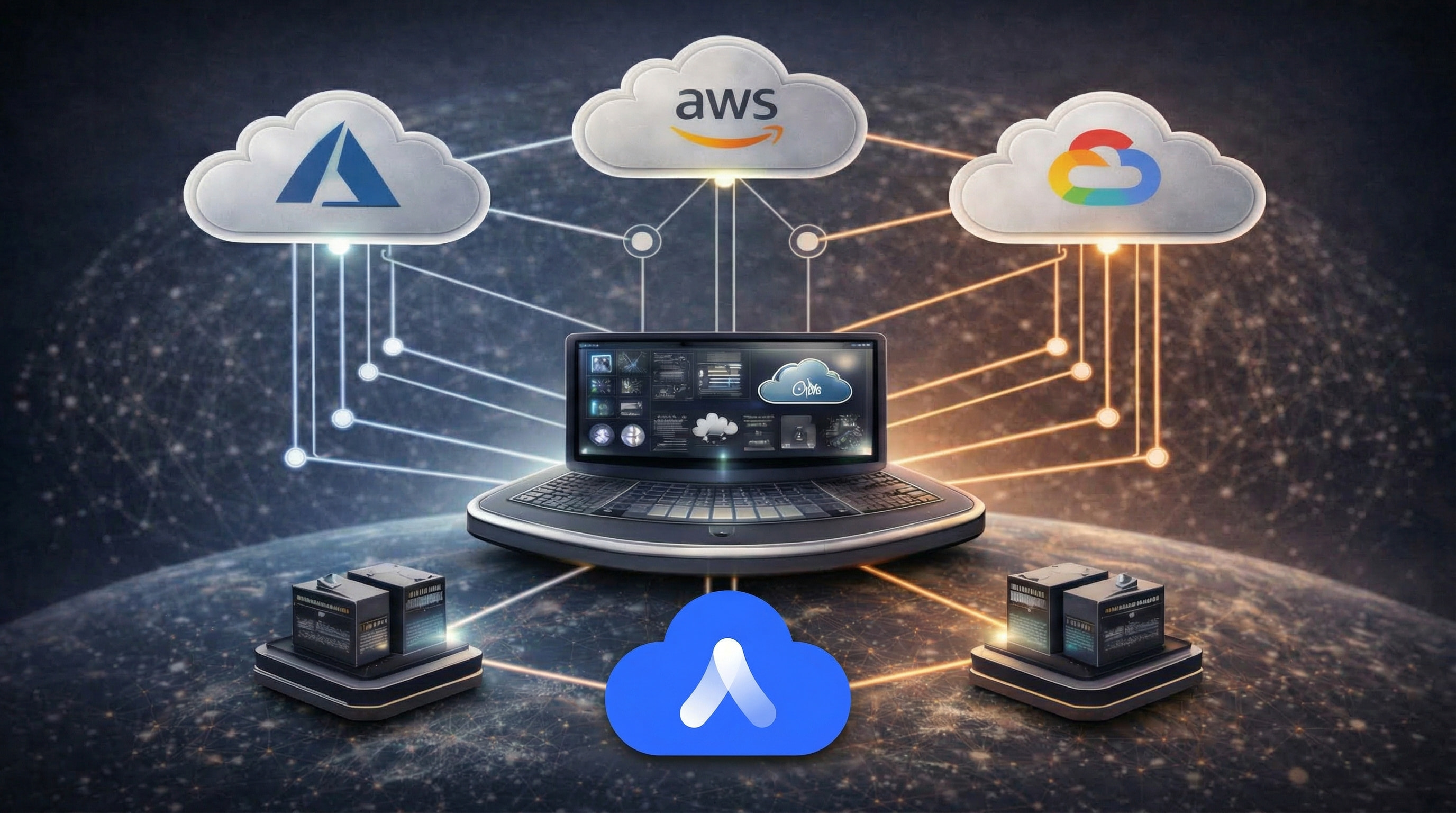
Multi-cloud interoperability is the solution to this growing complexity gap. It enables organizations to operate across cloud environments through a unified control layer, reducing cost, accelerating innovation, and limiting vendor lock-in.
This is no longer a technical optimization. It is a business imperative.
The Multi-Cloud Complexity Problem
Multi-cloud adoption promises flexibility. In practice, it often produces operational drag.
1. API Fragmentation
Every cloud provider uses proprietary APIs and data models. Even within a single provider, different services require unique toolkits and workflows.
Proprietary APIs across AWS, Azure, GCP, and private environments create an operational “tax” that slows innovation and increases cost.
Teams end up maintaining multiple integration patterns just to provision:
- Virtual machines
- Databases
- Storage
- Containers
Instead of building business functionality, they maintain cloud plumbing.
2. The Hybrid Gap
Public cloud and private infrastructure do not map cleanly. Differences in virtualization, networking, and orchestration introduce friction in:
- Migration planning
- Disaster recovery
- Security policy enforcement
- Cost optimization
Without abstraction, every hybrid decision becomes a custom engineering effort.
3. Cost Governance Breakdown
Cloud cost waste is a well-documented issue across industries. Without standardized visibility and controls, each cloud becomes its own financial silo.
Organizations struggle with:
- Over-provisioned environments
- Always-on workloads
- Department-level budget overruns
- Limited real-time forecasting
When cost visibility is fragmented, accountability is diluted.
What Multi-Cloud Interoperability Actually Means
Interoperability does not mean “using multiple clouds.”
It means operating across clouds as if they were one.
True interoperability provides:
- A unified control plane
- Standardized API calls
- Consistent governance policies
- Abstracted infrastructure differences
- Cloud independence without re-architecting applications
The Anantyx Multi-Cloud Interoperability Hub (MIHub) model addresses this by acting as a universal translator. Developers interact with a standardized interface, while the system handles provider-specific API translation behind the scenes.
Instead of coding separately for EC2, Azure VMs, or private virtualization, teams operate against unified object models such as:
- Instance
- DataSource
- Storage
This reduces duplication and restores focus to business outcomes.
Why This Matters Now
Three trends are accelerating the urgency of interoperability.
1. CFO-Level Cost Scrutiny
Cloud spend is now a board-level discussion. Organizations need:
- Real-time cost visibility
- Forecasting before provisioning
- Guardrails that prevent overspend
- Clear allocation by team or project
Without interoperability, each cloud requires separate financial controls thus multiplying complexity.
2. AI and Compute Variability
AI workloads demand rapid provisioning of GPUs, storage, and data services. These resources often span multiple cloud providers.
If every environment requires unique provisioning logic, AI adoption increases infrastructure friction instead of productivity.
Interoperability allows organizations to provision AI environments in a standardized, governed way regardless of provider.
3. Vendor Lock-In Risk
Cloud providers innovate quickly. Strategic flexibility requires the ability to:
- Add a new provider
- Migrate workloads
- Optimize for pricing changes
- Avoid architectural dead-ends
Without abstraction, migration becomes re-engineering.
Where Most “Cloud Management Platforms” Fall Short
Many tools provide dashboards. Few provide true interoperability.
A dashboard layered on top of fragmented APIs does not eliminate fragmentation.
True interoperability requires:
- API normalization
- Message translation layers
- Identity federation
- Asynchronous task orchestration
- Cross-cloud governance enforcement
Without these architectural components, complexity remains - just hidden behind another UI.
How Anantyx ACC Enables Practical Interoperability
Anantyx Cloud Command (ACC) operationalizes multi-cloud interoperability through a layered architecture designed specifically to abstract provider complexity.
At its core:
- A unified API layer standardizes cloud requests.
- A message translation engine converts standardized calls into provider-native APIs.
- Identity and access management enforce centralized governance.
- Cost controls and budget guardrails apply consistently across environments.
- Users interact through simplified, plain-language interfaces and not through cloud consoles.
ACC is designed as a secure bridge between end-users and multi-cloud infrastructure.
Instead of requiring business users to understand AWS, Azure, or private cloud terminology, ACC translates intent into governed, compliant cloud actions.
The result:
- Faster provisioning (minutes, not weeks)
- Unified cost visibility across teams
- Reduced reliance on cloud-specific specialists
- Elimination of shadow IT through enforced IAM and MFA
ACC does not replace underlying cloud providers. It normalizes them.
Strategic Impact of Multi-Cloud Interoperability
Organizations that implement true interoperability gain:
Reduced Operational Overhead
Fewer redundant integrations and less dependence on provider-specific expertise.
Faster Time-to-Market
Developers focus on features, not infrastructure differences.
Standardized Governance
Security policies, cost controls, and provisioning guardrails apply uniformly.
Future-Proof Architecture
New providers or services can be integrated without redesigning applications.
The Competitive Shift
Cloud diversity is inevitable.
The competitive advantage will not belong to organizations that use the most cloud platforms but to those that can operate across them seamlessly.
Multi-cloud interoperability is how that happens.
In the next article, we will examine the architectural components required to build a true interoperability layer and why API translation is only one part of the equation.
_compressed.jpg)
_With%20Logo.jpg)