Multi-Cloud Interoperability Requires More Than a Dashboard
Most cloud management tools provide visibility not interoperability. Learn why API normalization and governance abstraction are critical.

Konstantin brings the Anantyx vision to life through exceptional technical execution.
_compressed.jpg)
Why Most Cloud Management Platforms Don’t Solve the Real Problem
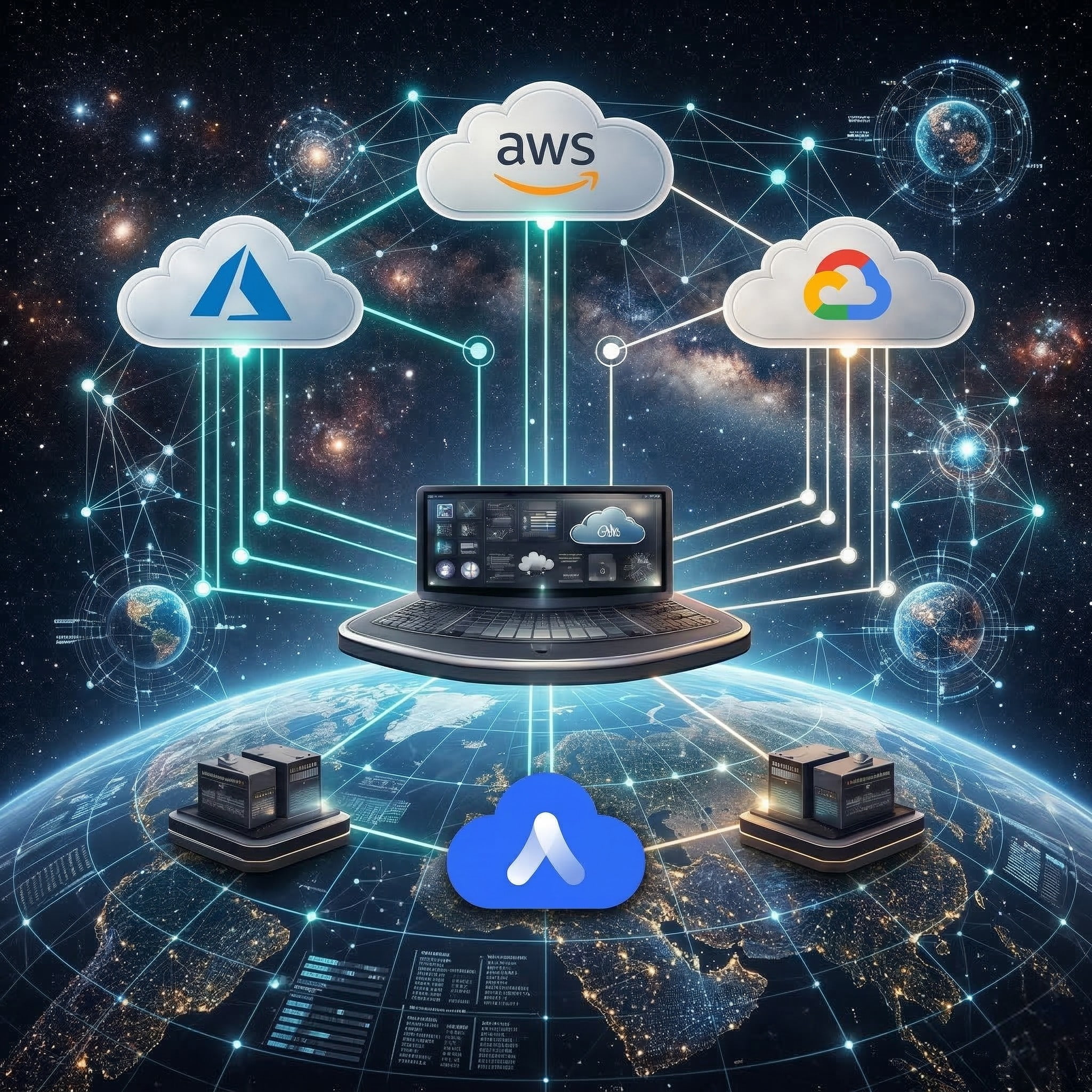
As organizations expand across AWS, Azure, Google Cloud, private infrastructure, and SaaS ecosystems, many turn to “cloud management platforms” to reduce complexity.
Most discover the same problem:
- A dashboard is not interoperability.
- True multi-cloud interoperability requires far more than centralized visibility. It requires the ability to standardize operations, normalize APIs, enforce governance consistently, and abstract provider-specific complexity across environments.
- Without those architectural capabilities, organizations simply add another layer on top of fragmentation.
This article examines the difference between cloud visibility and true interoperability, and why the distinction matters for cost control, governance, scalability, and long-term cloud strategy.
The Industry Misconception
Many platforms market themselves as “multi-cloud management” solutions because they aggregate metrics or provide centralized monitoring.
These tools often help organizations in one or two areas:
- View cloud spend
- Monitor workloads
- Receive alerts
- Provision through templates
Those capabilities are useful.
But they do not solve the underlying interoperability challenge.
The core problem remains:
- AWS uses different APIs than Azure
- Azure differs from Google Cloud
- Private infrastructure introduces additional abstractions
- Containers, VMs, databases, and storage services all behave differently
A dashboard may visualize these environments, but it does not unify them.
Visibility vs. Interoperability
The distinction is important.
Visibility Platforms
Primarily provide:
- Monitoring
- Reporting
- Cost dashboards
- Alerting
- Inventory tracking
These tools sit above cloud providers.
They observe complexity.
Interoperability Platforms
Provide:
- API normalization
- Standardized provisioning logic
- Policy enforcement
- Translation between cloud-native services
- Unified governance
- Cross-cloud orchestration
These platforms operate between users and cloud providers.
They reduce complexity.
Why This Difference Matters
When interoperability is missing, organizations experience growing operational friction as cloud adoption scales.
1. Development Complexity Expands
Teams must write different workflows for:
- AWS EC2
- Azure Virtual Machines
- Google Compute Engine
- Kubernetes clusters
- Private virtualization environments
As described in the MIHub (Multi-Cloud Interoperability) framework, proprietary APIs across providers create a “complexity gap” that forces organizations to maintain cloud-specific tooling and expertise.
Over time:
- Engineering velocity slows
- Integration costs rise
- Technical debt compounds
2. Governance Becomes Inconsistent
Without a standardized control layer:
- Security policies drift
- IAM enforcement varies
- Budget controls become siloed
- Auditability weakens
This is especially problematic in:
- Higher education
- Healthcare
- Public sector
- Financial services
Where compliance requirements span multiple environments simultaneously.
3. Cloud Costs Become Harder to Control
Cloud waste is rarely caused by infrastructure alone.
It is usually caused by operational fragmentation:
- Duplicate environments
- Idle resources
- Inconsistent shutdown policies
- Department-level shadow IT
Without centralized policy enforcement, every cloud environment develops independently.
What True Interoperability Looks Like
A real interoperability architecture includes several foundational components.
Unified API Gateway
Instead of developers interacting directly with provider-native APIs, requests pass through a standard interface.
The platform translates those requests into provider-specific commands behind the scenes.
For example:
- One “Instance” request
- Multiple provider translations:
- AWS EC2
- Azure VM
- Private virtualization
- Container platforms
This abstraction model is central to the Multi-Cloud Interoperability Hub (MIHub) architecture.
Translation and Messaging Layers
Interoperability requires orchestration.
A true platform must:
- Queue requests
- Handle asynchronous tasks
- Normalize responses
- Manage retries and failures
- Maintain state across providers
This is infrastructure coordination, not dashboard rendering.
Centralized Identity and Governance
A unified platform should enforce these consistently across all environments:
- MFA
- LDAP/SAML/OIDC integration
- Role-based access controls
- Budget guardrails
- Provisioning policies
Without centralized governance, organizations simply decentralize risk.
How Anantyx ACC Approaches Interoperability
Anantyx Cloud Command (ACC) was designed specifically to operate as a secure abstraction layer between users and cloud infrastructure.
Its architecture includes:
- API translation services
- Unified access controls
- Messaging and orchestration layers
- Multi-cloud connectors
- Centralized governance enforcement
Rather than exposing users directly to AWS, Azure, or Google Cloud consoles, ACC abstracts provider complexity through standardized workflows and simplified provisioning.
This approach allows:
- Faster environment deployment
- Reduced operational overhead
- Unified cost visibility
- Consistent governance enforcement
Why This Matters for AI and Modern Workloads
AI initiatives are accelerating infrastructure fragmentation.
Teams increasingly require:
- GPUs
- Temporary compute clusters
- Multi-cloud data access
- Secure experimentation environments
If every provider requires unique provisioning logic, AI adoption amplifies operational complexity instead of reducing it.
Interoperability changes this dynamic.
With standardized provisioning and governance:
- AI environments can launch faster
- Budget policies remain enforceable
- Security controls stay centralized
- Innovation scales without infrastructure sprawl
The Strategic Shift
Organizations aren't advancing based on how many cloud providers they use.
They advance based on how efficiently they operate across them.
The future is not:
- Single-cloud dominance
- Manual integration
- More dashboards
The future is operational abstraction.
That means:
- One governance model
- One provisioning framework
- One operational language
- Multiple cloud providers underneath
Closing Thought
Cloud complexity is now unavoidable.
Operational fragmentation is not.
The organizations that succeed in the next phase of cloud adoption will not be those with the most infrastructure. They will be those with the simplest operating model across increasingly complex environments.
That is the real promise of multi-cloud interoperability.
_With%20Logo.jpg)